How much slope does a backyard zip line need?
The slope, sag and anchor heights from five zip line makers' instructions, put side by side and turned into inches for 50, 75 and 100 foot runs. Then the two places where the figures people quote go wrong: the brake the 6% depends on, and the anchor the sag is measured from.
Short answer
Drop the cable 3% of the run between the anchors if the line has only a stop block or spring brake: 18 in over 50 ft, 36 in over 100 ft. Go up to 6% (72 in over 100 ft) only with a bungee brake you have tested. Under the heaviest rider the cable should sag at least 2% of its length below the lower anchor, 24 in on a 100 ft line.
On this page
The short answer
Drop the cable 3% of the run between the start and end anchors: 18 inches over 50 feet, 27 inches over 75 feet, 36 inches over 100 feet. That is the maximum for a line that ends in a stop block or a spring brake. Go up to 6% only with a bungee brake that has been installed and tested. Then set the tension so the cable sags at least 2% of its length under the heaviest rider, measured below the lower anchor: 24 inches on a 100 foot line.
The figure most people find is "3% to 6%", from the top of Zip Line Gear's slope guide1. Further down, the same page says a line without a professionally engineered braking system should not exceed 3%, and that 3 to 6% is possible only with a brake such as a bungee brake, installed and tested1. Every maker here that gives a percentage sets the same 3% ceiling without a bungee256. 6% is the limit with one, not a target.
Five makers' instructions, side by side
| Maker and document | Cable slope between anchors | Sag or tension | Trees, clearance, riders |
|---|---|---|---|
| Zip Line Gear guide and handbook (2020) | 3% with a stop block, never over 3% with a spring brake; up to 6% with a bungee brake | At least 2% of length under the heaviest load, below the end anchor | 12 in trees; 7 ft clear under the loaded line |
| Hyponix install guide | 3% maximum | 2% of length at the lowest point under the test weight | 12 in diameter or 38 in around; 5 ft clear below and each side |
| Cable-ride.com (EU kits) | 3% without a brake; up to 6% with a bungee or BrakeHawk | 2% below the end anchor | 30 cm trunks; 2.1 m clear below, 1.5 m each side; 150 kg on the pulley |
| Slackers SLA.500 Night Riderz | Fixed heights: 54 in over 100 ft (4.5%), 24 in over 50 ft (4%) | No figure: a 250 lb test weight must stop short of the end clamps | 12 in trees measured 6 ft up; ages 8+, 200 lb; 100 ft maximum |
| Zip Line Fun Total Z35 to 100X | The same 54 in over 100 ft, raised with the rider's height | About 200 lb of tension: a 5 lb bag lowers mid-cable 4 in | Supports holding 1,250 lb; level ground; ages 8+, 250 lb |
- There are two families of kit. Zip Line Gear, Hyponix and Cable-ride work from percentages, for runs up to 1,000 feet (Zip Line Gear)1 or 90 m (Cable-ride)6. Slackers and Zip Line Fun sell children's seat kits capped at 100 feet and print a table of anchor heights instead.
- The seat kits run steeper than 3%. Slackers sets the start at 132 inches and the end at 78 inches on a 100 foot course, a 54 inch drop, and warns: "Do not add additional slope to the cable!"3 Zip Line Fun's table carries the same 54 inches4. Neither relies on a bungee. They rely on a slack cable: the rider starts slowing in the last third and finishes "going slightly uphill at the end"3. Slackers' ZipSpring brake is made for all its ziplines7, on heights steeper than the 3% Zip Line Gear allows with any spring brake2, so do not mix one maker's brake with another's heights.
- Zip Line Fun's text and table disagree. The written step adds 30 inches at the start for the full ride length; the table beside it adds 54 inches over 100 feet4. The table matches Slackers line for line. Ask the maker.
Slope in inches for 50, 75 and 100 foot runs
| Run between anchors | 3%: stop block or spring brake | Slackers and Zip Line Fun tables | 6%: tested bungee brake |
|---|---|---|---|
| 50 ft | 18 in | 24 in | 36 in |
| 75 ft | 27 in | 39 in (between the 70 and 80 ft rows) | 54 in |
| 100 ft | 36 in | 54 in | 72 in |
The slope is the difference in elevation between the anchors, not in how high each sits on its tree. On a hillside the ground supplies part of it. Zip Line Gear's worked example is a 180 foot run where the ground falls 8 feet: the 3% slope rounds to 5 feet, the end anchor goes at 11 feet, and the start anchor at only 8 feet2. Slackers does the same in inches: take the fall of the ground off the start height, never below 78 inches, and do not set up on a steep hill3. Site prep and leveling shows how to measure the fall with a string line.
Sag: how tight the cable should be
Sag is how far the cable dips below the end anchor with the heaviest rider at its lowest point. Zip Line Gear's worksheet defines it as the end anchor height minus the cable height under the test weight, minimum 2% of the length2. Hyponix gives the same 2%5.
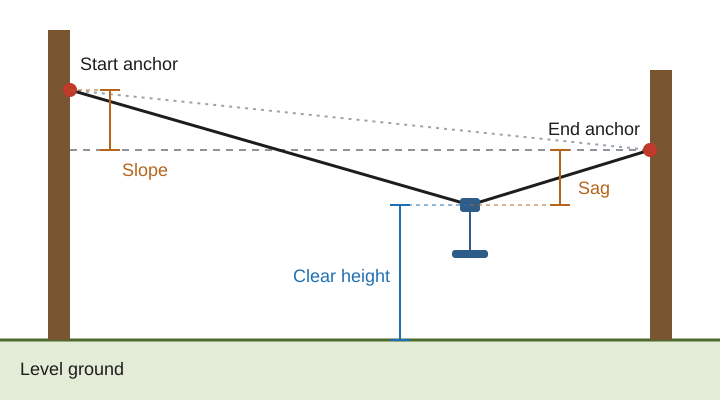
That is the second confusion. Cable-ride gives "a sag of 8%" in one line and 2% from the end anchor in the next: at 6% slope, a cable 2% below the end anchor is 8% below the start anchor6. Same cable, two reference points. Use the end anchor.
Sag sets the pull on your trees. For a rider at mid-span, basic statics puts the cable tension at about the rider's weight times the length, divided by four times the sag. At 2% sag that is 12.5 times the rider's weight: around 2,500 lb for a 200 lb rider. Halve the sag and the pull doubles. It is a rough scale (it ignores the cable's weight and the slope), but it fits the makers: Hyponix says cables can put 800 to 3,000 lb of horizontal force on an anchor5, Cable-ride up to 1,500 kg6, and Zip Line Fun wants supports that hold 1,250 lb4. The ninja line page describes the same effect on webbing.
How high the anchors go
| Run | Minimum sag | End anchor (sag + 7 ft) | Start anchor at 3%, level ground |
|---|---|---|---|
| 50 ft | 12 in | 8 ft | 9 ft 6 in |
| 75 ft | 18 in | 8 ft 6 in | 10 ft 9 in |
| 100 ft | 24 in | 9 ft | 12 ft |
The seat kits sit far lower, because a child rides a seat a few feet off the ground instead of hanging in a harness above a 7 foot clearance. Slackers fixes the end at 78 inches and the start at 132 inches for 100 feet, low enough that a lost grip is a fall of a few feet, high enough that feet do not drag3. Zip Line Fun sets the low end at the rider's height plus 30 inches, 78 inches for a 48 inch child, raising the line 6 inches per 6 inches of rider height; a rider more than 6 inches off that height waits until the cable is reset4.
That height is a fall height. The CPSC public handbook calls track rides upper body equipment needing "significant upper body strength", keeps them off toddler and preschool playgrounds, and puts the handle 64 to 78 inches above the surfacing8. The zip lines buying guide covers public units; at home, backyard surfacing and fall height and use zones set what goes under the low point. Slackers points to the CPSC handbook for cushioning, and Zip Line Fun rules out grass and packed earth34.
Trees, posts and clearance
Three of the four manuals that size a tree give 12 inches of trunk diameter, or 38 inches around235; Cable-ride says 30 cm6. Slackers measures 6 feet up3. Hyponix and Zip Line Gear set wooden posts 4 feet in the ground or 10% of the post length plus 2 feet, with guy cables and ground anchors25, and Slackers wants an engineer's opinion on any post because of the side load3. That sideways pull is why the swing set footings in how deep to set legs in concrete and the rules in anchoring a playset do not carry over.
Tree swings explains why anything wrapped tight around a living trunk constricts it as it grows. The kits sleeve the cable in tubing and wrap it in a loose teardrop, the first clamp well off the trunk: 2 feet for Hyponix, 1.5 times the trunk diameter for Slackers35. Torque those clamps as hardware and fasteners describes; both kits give 30 foot pounds for the first35.
The corridor needs side room too: 5 feet each side (Hyponix), 1.5 m (Cable-ride), 6 feet from any structure (Zip Line Fun)456, and Slackers wants 100 feet from where any power line could fall3. If that does not fit, see small yards.
Test it before anyone rides
Slackers asks for two tests: 250 lb hung 5 feet from each end to load the anchors, then 250 lb on the trolley, released from the start five times. It must slow past the midpoint and stop short of the first clamp; if it hits, loosen the turnbuckle, or raise the finish or lower the start3. Zip Line Gear puts the stop block 5 feet from the end anchor and warns that a stop block is not a braking system2. Re-tension after the speed test, because new cable stretches3, and add the line to the annual maintenance round. Below 32 F, Slackers takes the whole line down and Zip Line Fun the trolley and seat34, alongside the rest of winterizing.
Where these numbers stop applying
These are makers' figures for their own kits, and none cites a standard for its slope or sag. Zip Line Fun says its system conforms to ASTM F1148, the home playground standard, "where applicable"4; the standards explainer sets out what that covers. The seat kit tables stop at 100 feet3, and Zip Line Gear's guidance is for lines under 1,000 feet and does not replace an engineer1. Public and commercial lines are outside these figures. Rider limits run from 200 lb (Slackers) to 250 lb (Zip Line Fun)34, and Slackers tests at 250 lb, above its own limit3; swing set weight limits covers how ratings are set on other home equipment.
What to do next
Measure the run and the fall of the ground. Use your kit's table or worksheet; on a percentage kit, 3% unless a bungee brake is in the box. Mark the anchors, tension until the line is nearly straight, then load-test and speed-test at the heaviest rider's weight and check the sag against 2% of the length. Before the first ride, settle who watches the line, which supervision covers.
Frequently asked questions
How much drop does a 100 ft zip line need?
36 in (3 ft) between the anchors if the line ends in a stop block or spring brake, which is the 3% Zip Line Gear and Hyponix set as the maximum without a bungee brake. Up to 72 in (6 ft) with a bungee brake that has been installed and tested. Slackers and Zip Line Fun children's seat kits use 54 in over 100 ft on level ground, with a slack cable instead of a bungee.
How much sag should a zip line have?
At least 2% of the cable length when the heaviest rider is at the lowest point: 12 in on a 50 ft line, 24 in on 100 ft. Measure it below the end (lower) anchor, not the start anchor. Less sag than that means the cable is too tight, and the pull on the trees rises fast as the sag shrinks.
How high should the end of a backyard zip line be?
It depends on the kit. Zip Line Gear's method puts the end anchor at the sag plus 7 ft, 9 ft on a 100 ft line, so an adult in a harness clears the ground. Slackers fixes the end at 78 in for a child on a seat, and Zip Line Fun sets it at the rider's height plus 30 in. Use the figure for the kit you bought.
Can I put a zip line on flat ground?
Yes. On level ground all the slope comes from the anchor heights: the start anchor goes 3% of the run higher than the end anchor, 36 in on 100 ft, or by the kit's table. On a hill, subtract the fall of the ground from that difference. Zip Line Fun's instructions ask for level ground and tell you to contact them first if yours is not.
Is 6% slope too steep for a backyard zip line?
Without a bungee brake, yes. Zip Line Gear, Hyponix and Cable-ride all cap a line with only a stop block at 3%, and Zip Line Gear says never more than 3% with a spring brake. 6% is the upper limit with a bungee brake that has been installed and tested with the heaviest rider, not a target.
Sources
- 1Understanding Zip Line Slope and Sag. Zip Line GearSlope 3% to 6%; 3% maximum without a professionally engineered brake, 3% to 6% only with a tested brake such as a bungee brake; sag at least 2% of length under maximum load; 7 ft clearance under the heaviest riders; platforms 5 to 6 ft below the anchor; for lines under 1,000 ft
- 2Installation and Safety Handbook, rev. 3.2020. Zip Line Gear, 2020Worksheet: slope = length x 0.03 with a stop block only, x 0.06 with a bungee brake; sag = length x 0.02 below the end anchor; end anchor = sag + 7 ft; never more than 3% with a spring brake; stop block 5 ft from the end anchor; 12 in trees
- 3SLA.500 Night Riderz zipline kit with seat, instructions and safety rules. b4 Adventure (Slackers), DC:081016Ages 8+, 200 lb maximum rider; trees 38 in around or 12 in diameter measured 6 ft up; start 132 in and end 78 in for 100 ft; do not add additional slope; 250 lb load and speed tests; 100 ft maximum course
- 4Zipline bundle instructions, Total Z35, Z40, Z70, Z80 and 100X. Zip Line Fun (Adventure Parks), 2021Ages 8+, up to 250 lb; supports holding 1,250 lb; level ground, 6 ft from obstructions; low end = rider height + 30 in; height table by run length; about 200 lb cable tension, checked with a 5 lb bag lowering the cable 4 in
- 5How To Install A Backyard Zip line Kit. Hyponix Sporting GoodsSlope 3% maximum; sag 2% of length at the lowest point under the test weight; trees 12 in diameter or 38 in around; 5 ft clear below and to each side
- 6How to install a zipline. Cable-ride.com6% slope only with a bungee brake or BrakeHawk, otherwise 3% maximum; 2% sag from the end anchor, 8% measured from the start anchor at 6%; 30 cm trunks; 2.1 m clear below and 1.5 m each side; up to 1,500 kg on the anchor; never more than 150 kg on the pulley
- 7SLA.702 ZipSpring instructions. b4 Adventure (Slackers), 20175.25 ft spring brake made for use with all Slackers ziplines
- 8Public Playground Safety Handbook. US Consumer Product Safety Commission, 2010Publication 325, section 5.3.2 track rides: not for toddlers or preschoolers, no obstacles along the path, handle 64 to 78 in above the surfacing, 4 ft between two track rides