How deep should swing set legs be set in concrete?
Ten installation documents, from a $200 metal kit to a commercial frame, put side by side: the hole each one asks for, how wide, and the detail most of them leave out, which is the ground the depth is measured from. Then the frost line, and why it decides the answer in a cold yard.
Short answer
Dig to the depth your manual gives, measured from the bottom of the surfacing, not the lawn. The home kits compared here ask for 5 to 20 in; commercial frames 18 to 42 in below the surfacing. Where the ground freezes, carry the concrete down to the local frost depth from your building department (42 or 60 in in Minnesota), with the extra depth below the leg.
On this page
The short answer
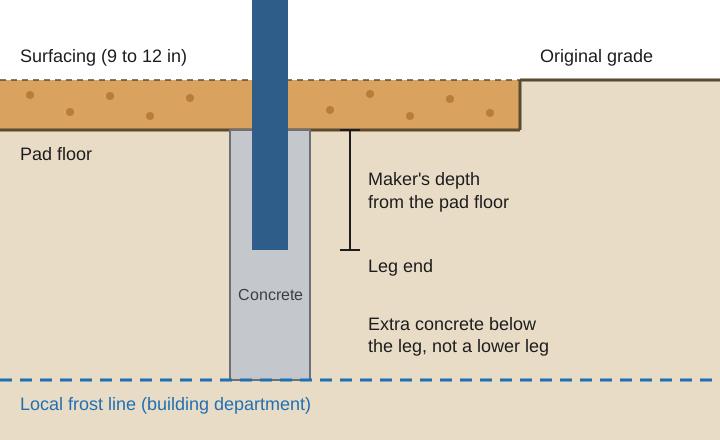
Set the legs as deep as your manual says, and measure that depth from the bottom of the surfacing, not from the lawn. Where the ground freezes in winter, keep digging: the concrete goes down to the local frost depth, which your building department publishes. The extra depth is concrete below the leg, not a leg sunk lower.
The two numbers people find disagree for a reason. Kit manuals give a hole sized to stop a light frame lifting and tipping: 5 to 20 inches in the home manuals compared here. The frost advice on the anchoring page, up to 48 inches or more in northern states, is about something else: frozen soil lifting anything shallow. Neither number is wrong. The deeper one governs, and in a cold yard that is the frost depth.
Ten installation documents, side by side
| Manual | Hole depth | Hole width | Measured from |
|---|---|---|---|
| NATUS Rochester, XDP Rising Sun, Sportspower 4 swing | 5 in, leg on 2 in of brick or gravel | 12-5/8 in at the top, wider below | Ground, then dirt and surfacing on top |
| Swing Set Swn0403 (Lowe's) | 350 mm (13.8 in) | 350 mm square | Ground, concrete no higher than grade |
| ALEKO BSW07 nest swing | 20 in | 12 x 12 in | Ground, concrete level with the surface |
| Jensen H106, heavy in-ground | 24 in, brick in the bottom | 24 in round | Not stated; dirt on top, space left for surfacing |
| American Swing Products guide | 24 in, brick under each leg | 24 in | Not stated |
| Willygoat, posts and most swings | 18 in | 18 in | Below the surfacing |
| Willygoat, 5 in single post swing | 36 in | 18 in | Below the surfacing |
| SportsPlay 581-486F, 8 ft swing | 42 in (3 ft 6 in), pipe 2 ft into it | 12 in round | Below 12 in of surfacing |
| Jungle Gym SJG201 | Not given | Not given | "Placed in concrete, or anchored" |
Three things stand out.
- The kit range is 5 to 20 inches, not 14 to 20. The shallowest figure belongs to a drawing used in at least three metal set manuals: a 5 inch deep, 12-5/8 inch wide pad of about 45 pounds of concrete per leg, with the leg end standing on 2 inches of brick or gravel345. Those manuals make concrete compulsory only on sandy soil and leave the choice to "your local contractor" everywhere else3.
- Home manuals measure from the lawn; commercial ones from the bottom of the surfacing. Swn0403 tells you to keep the concrete no higher than ground level and cover it with soil1; ALEKO fills the hole "level with ground surface"2. Willygoat prints "does not include safety surfacing depth" against every footing size it lists8, and SportsPlay draws its 3 ft 6 in footing underneath a 12 inch layer of surfacing9.
- Only one maker mentions climate. SportsPlay says its footings suit "most applications", that "varying soil & climatic conditions may require deeper and heavier footings in some areas", and to check local building codes9. Nobody else says anything about frost.
Where to measure the depth from
Start at the base of the protective surfacing. The CPSC public handbook asks for concrete footings to sit "below ground level and beneath the base of the protective surfacing material", both so nobody trips on them and so a child who falls does not land on the concrete11. The home handbook says the same in fewer words: anchors buried or covered with surfacing12.
That turns into a measurement in two common cases.
- Surfacing set into a dug pad. Site prep and leveling suggests excavating the pad so the finished loose fill sits near grade. Measure the hole from the pad floor. A 20 inch ALEKO hole dug from the old lawn level before a 9 inch pad is excavated leaves 11 inches of concrete in the soil, and a concrete collar standing in the fall zone.
- Surfacing built up on top of the lawn behind a border. Measure from the lawn, which is now the base of the surfacing. Nothing has to change in the hole, but the beam and every seat are now closer to the play surface by the depth of the fill.
That second effect is why the commercial makers measure from below the surfacing. SportsPlay says that if the surfacing will be less than 12 inches, "additional pipe should be put in concrete" to keep the frame at its proper height9. Willygoat tells installers to dig the nest swing footing deeper so the top rail finishes 7 feet above the play surfacing8. On a home set, the check that matters is the seat: the 5 inch kits ask for at least 8 inches between the seat and the ground surface3, and how high a swing seat should be sets the target at 12 to 20 inches above the compacted surfacing. Backyard surfacing gives the depth of fill to plan for.
Maker depth or frost depth: which one wins
In ground that freezes, frost depth wins. The manuals size a hole to hold the frame down against a swinging child; none of them sizes it against the ground moving. Wet soil expands as it freezes and lifts what is shallow, then leaves it slightly higher when it thaws. Winterizing a playset describes what that does to footings that stop short of the frost line: they lift and tilt, and a frame lifted unevenly is a frame out of square.
Building codes deal with this for houses. The International Residential Code puts exterior footings at least 12 inches below undisturbed ground, and protects them from frost by taking them below the frost line the local jurisdiction sets13. Minnesota's rule shows how far apart those lines can be inside one state: 3 1/2 feet in the southern counties and 5 feet in the northern ones, for building footings, unless a soils engineer says otherwise14.
A swing set is not a building, and no manual compared here asks for frost depth. But SportsPlay's instruction to check local codes for climate9 points the same way as the site's anchoring guidance: ask the building department for the frost depth, and treat it as the footing depth wherever it is deeper than your manual's figure.
The depth for your yard, worked through
| Your situation | Hole depth, from the base of the surfacing |
|---|---|
| No frost, kit with a stated depth | The manual's depth: 5 to 20 in for the kits here |
| No frost, heavy in-ground frame | The manual's depth: 24 in (Jensen, American Swing) |
| Frost depth 36 in, kit asks for 20 in | 36 in, leg set at the kit's height, concrete below it |
| Southern Minnesota (Zone II), any set | 42 in |
| Northern Minnesota (Zone I), any set | 60 in |
| Manual gives no depth (Jungle Gym SJG201) | Frost depth, or call the maker |
On a 4 x 4 wooden leg the question changes. Burying timber in concrete traps water at the line where it leaves the footing, which is why the anchoring page prefers a pier with a galvanized post base, and why DIY playset builds need ground contact lumber for anything that touches soil. Timber rot and repair covers what happens when that line goes soft.
How wide, how much concrete, and how long to wait
Width comes from the same documents. The kits want about 12 inches (ALEKO, the 5 inch drawing) or 350 mm (Swn0403)123. Jensen sets the most useful rule of thumb: at least 4 inches of concrete around the end of the pipe, in a 2 foot round hole, using two 80 pound bags per hole and topping up with dirt6. The 5 inch kits put about 45 pounds of concrete in each leg3. The site's anchoring page budgets two or three 60 pound bags for a typical footing.
Cure times vary more than they should. Jensen says 24 hours, then a test without a child on the seat6. The 5 inch kits say 6 to 7 days3. ALEKO says to wait until the concrete is fully set and cured, by the concrete maker's instructions, and Swn0403 until it is completely dry12. When in doubt, use the longest figure, because the first hard swing pulls up on the leg that is least set.
Where this stops applying
The depths in the table are what each maker printed for its own frame. They do not transfer between products: a 5 inch pad designed for a light A-frame says nothing about a 10 foot commercial beam with six seats. Taller beams, heavier riders and more seats load the footings harder, which is what swing set weight limits works through.
Frost depth is a local number. Minnesota is one example, not a national figure, and your building department may also have rules about permits or setbacks for play equipment: permits and HOA rules covers those. ASTM F1148, the home playground standard, is a paid document and was not read for this page.
What to do next
Read the anchoring section of your manual and write down its depth and width. Ask the building department for the frost depth. Dig to the deeper of the two, from the base of the surfacing you plan to lay. Then follow assembling a playset yourself for the order of work, since most frames are assembled and levelled before the concrete goes in, and budget the fill with the mulch quantity calculator.
Frequently asked questions
How deep should a metal swing set leg go in concrete?
As deep as the manual says, measured from the bottom of the surfacing. The light metal kits compared here range from 5 in (NATUS, XDP and Sportspower, leg on 2 in of brick) to 20 in (ALEKO). Heavy in-ground frames from Jensen and American Swing use holes 2 ft deep and 2 ft across. In ground that freezes, take the concrete down to the local frost depth.
Do swing set footings have to go below the frost line?
No manual compared here requires it, and a swing set is not a building, so the frost depth in your building code is not written for it. The soil does not know that. A footing that stops above the frost line can be lifted as the ground freezes, and SportsPlay's own instructions say climate may call for deeper footings and to check local codes. In freezing ground, use the building department's frost depth.
Is 2 ft deep enough for swing set posts?
It is the figure Jensen and American Swing give for their heavy in-ground frames, and deeper than any home kit here. It is not deep enough where the frost depth is greater, such as Minnesota's 42 in in the south of the state or 60 in in the north. Measure the 2 ft from the base of the surfacing, not from the lawn.
Does the concrete go to the top of the hole?
Not on a backyard set with loose fill. The home kits finish the concrete at ground level and cover it with soil; Jensen fills the top with dirt, leaving space for surfacing. The CPSC public handbook puts footings below ground and beneath the base of the protective surfacing, so nobody falls onto the concrete edge.
How wide should the hole be for a swing set leg?
Home kits ask for about 12 in (ALEKO, the 5 in Sportspower drawing) or 350 mm, about 14 in (Swn0403). Commercial frames use 12 in (SportsPlay), 18 in (Willygoat) or 24 in (Jensen, American Swing). Jensen sets a working minimum: at least 4 in of concrete all the way around the pipe.
Sources
- 1Swing Set Swn0403 instructions. Lowe's product document 68704968Ages 3 to 12; a 350 x 350 mm square, 350 mm deep, under each foot; concrete no higher than ground level, then covered with soil
- 2Nest Swing BSW07 manual. ALEKO, Home Depot product documentFooting hole 12 in long x 12 in wide x 20 in deep at each leg, filled level with the ground surface
- 3Rochester Metal Swing Set (MS-1004) owner's manual. NATUS Sports & Recreation, Home Depot product documentConcrete footing called the best base for an anchor; required in sandy soil; drawing shows 5 in deep, 12-5/8 in across the top, 2 in of brick or gravel under the leg; about 45 lb of concrete per leg; 6 to 7 days to dry
- 4Rising Sun 6 Leg Swing Set (76509) manual. XDP Recreation, updated 02/13/2017Same concrete anchoring text and 5 in footing drawing as the Rochester manual
- 54 swing metal swing set (14FT-6QSTL) owner's manual. Sportspower Ltd., Lowe's product document 70900241Same concrete anchoring text and 5 in footing drawing
- 6H106 Heavy 10 ft High 6 Swing 3 Bay installation instructions. Jensen Swing ProductsHoles 2 ft deep and 2 ft in diameter, a brick in the bottom, at least 4 in of concrete around the pipe, two 80 lb bags, dirt on top leaving space for surfacing
- 7How to Anchor a Swing Set: A Complete Guide. American Swing Products, 2020Holes 2 ft deep and 2 ft wide, a brick under each leg, filled nearly to the top
- 8General installation guide (PSWAS001WS). Willygoat, 20182500 PSI minimum; 18 x 18 in for structure posts and most swings, 12 x 18 in for slide feet and steps, 18 x 36 in for the 5 in single post swing, 24 x 24 in for posts with shade; none of them include safety surfacing depth; 12 in minimum loose fill
- 9581-486F 8 ft Heavy Duty Combination Swing installation. SportsPlay Equipment, rev. 06/20/2008Footings 12 in diameter, 3 ft 6 in deep below 12 in of surfacing, pipe 2 ft into the concrete; deeper footings may be required by soil and climate; check local building codes
- 10Jungle Gym Swing Set SJG201 manual. Lowe's product document 11493951Recommends the set be placed in concrete or anchored, below the level of the playing surface; no depth given
- 11Public Playground Safety Handbook. US Consumer Product Safety Commission, 2010Publication 325: anchoring devices such as concrete footings installed below ground level and beneath the base of the protective surfacing
- 12Outdoor Home Playground Safety Handbook. US Consumer Product Safety CommissionPublication 324: follow the manufacturer's anchoring instructions; anchors buried or covered with protective surfacing
- 132018 International Residential Code as adopted in Minnesota, R403.1.4 and R403.1.4.1. ICC, via UpCodesExterior footings at least 12 in below undisturbed ground; frost protection by extending below the frost line in Table R301.2(1)
- 14Minnesota Rules 1303.1600, Footing depth for frost protection. Minnesota Office of the Revisor of StatutesMinimum footing depth 5 ft in Zone I (northern counties), 3-1/2 ft in Zone II (southern counties)