How far apart should swings be on a swing set?
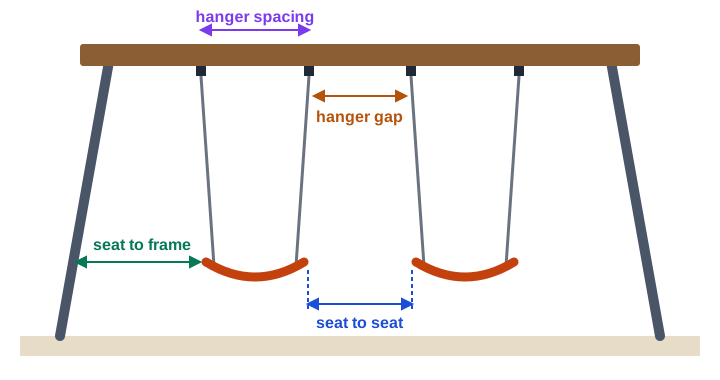
Home swing set rules ask for 8 inches between seats. Park rules ask for 24 inches between seats and 30 to the frame. Builders' guides quote both without saying which one they mean, and plenty of DIY plans measure at the beam, where neither number applies.
Short answer
On a backyard swing set, leave at least 8 inches between neighbouring seats, the CPSC home handbook minimum, and more wherever the beam allows. Public playgrounds use 24 inches between belt seats and 30 inches from a seat to the frame (CPSC Pub 325). Measure at the seats, not at the hangers. Disc and tire swings go in their own bay.
On this page
The short answer
On a home swing set, leave at least 8 inches between neighbouring seats, and more wherever the beam has room. On a public playground, belt seats sit 24 inches apart and 30 inches from the frame. Toddler buckets sit 20 and
- Disc and tire swings get a bay of their own.
The 8 inch figure is from the CPSC's home handbook, Publication 3241. The 24 and 30 inch figures are from its public handbook, Publication 325, Table 72. The confusion comes from builders' pages that give the public figures for a backyard set without saying so: Gorilla Playsets' spacing guide says swings "should be spaced at least 24 inches apart, with a minimum of 30 inches between each swing and the support structure"9, and Kids World Play Systems says 30 and 3010. Those are fine targets. They are not the home rule, and on a standard 10 ft beam with three swings they usually cannot be met.
Measure at the seats, hanging still and empty. Both handbooks draw the gap between seats, not between hangers.
What the two CPSC handbooks say
| Clearance | Home, Pub 324 | Public belt seat, Pub 325 | Public toddler bucket, Pub 325 |
|---|---|---|---|
| Seat to seat | At least 8 in | At least 24 in | At least 20 in |
| Seat to frame | Not drawn for belt seats | At least 30 in | At least 20 in |
| Hangers for one seat | No figure | At least 20 in apart | At least 20 in apart |
| Disc swing to support pole | At least 24 in | No figure | No figure |
| Swings per bay | Disc and 360 degree tire swings in their own bay | No more than two | Bucket seats in their own bay |
The home handbook gives "8 inches minimum for swings with limited sideways motion" and "24 inches minimum between swings with unlimited lateral motion (such as disk swings) and support poles"1. Its drawing shows 8 inches between two belt swings, and between a swing and the teeter-totter and lawn swing beside it. It does not draw a belt seat next to a leg.
The public handbook explains each figure. Seat to frame "minimizes collisions between a swing and the supporting structure", seat to seat "minimizes collisions between swings", and the 20 inch hanger spacing "reduces side-to-side motion"2. It also says no more than two belt swings per bay, and puts full bucket seats on a separate structure or at least a separate bay2.
One hanger maker's instructions credit the 8 inch figure to ASTM F1148-09, the voluntary home playground standard4. That standard is a paid document and was not read for this page. CPSC, ASTM and how the rules work explains why neither handbook is law for a backyard.
Eight layouts, side by side
| Source | Between swings | To the frame or beam end | Hangers for one seat |
|---|---|---|---|
| CPSC Pub 324, home | 8 in, at the seats | No belt seat figure | No figure |
| CPSC Pub 325, public belt | 24 in, at the seats | 30 in, at the seats | At least 20 in |
| Iron hanger sheet 29-6602 | 8 in minimum | 8 in for belts, more recommended | 17-1/2 to 20 in centres |
| Swing-N-Slide hangers NE 4888 | 8 in, hanger centre to centre | 8 in from structure | No figure |
| Swingan DIY set, 120 in beam | 8 in hanger gap | 12 in to beam end | 15 to 16 in |
| Eastern Jungle Gym plan, 10 ft | 12 in hanger gap | 18 in to beam end | 18 in |
| Family Handyman plan, 10 ft | 18 in hanger gap | 18 in to beam end | 16 in |
| Gorilla Playsets blog | 24 in, 30 to 36 suggested | 30 in | No figure |
Three things stand out.
- Two different 8 inch rules. The iron hanger sheet means 8 inches between swings4. Swing-N-Slide's hanger kit means 8 inches between hanger centres, "from existing hanging accessories, structural elements and/or other swing hangers"5. A gap at the beam is not the gap at the seats.
- Hanger spacing for one seat is narrower in DIY plans. The public handbook asks for 20 inches2 and the iron hanger sheet for 17-1/2 to 204. The three DIY plans use 15 to 18 inches678, less than the spacing the handbook says "reduces side-to-side motion"2.
- Commercial frames hang two, home plans hang three. Jensen's 8 ft commercial frame, sold as meeting ASTM F1487, hangs two swings on a 120 inch top rail11. The Eastern Jungle Gym and Family Handyman plans fit three swings on a 10 ft beam78.
A 10 ft beam, worked through
Most backyard swing beams are 10 ft, 120 inches. Lay out the Family Handyman plan: 18 inches from each end, 16 inches across each swing, 18 inches between swings8. That is 18 + 16 + 18 + 16 + 18 + 16 + 18 = 120.
| Swings on a 120 in beam | Hanger pairs | Gap left between pairs and to the ends | Can it reach 24 in between pairs? |
|---|---|---|---|
| Three, 16 in hangers | 48 in | 72 in over four gaps, 18 in each | No |
| Three, 20 in hangers | 60 in | 60 in over four gaps, 15 in each | No |
| Two, 20 in hangers | 40 in | 80 in over three gaps, about 26.7 in each | Yes |
So on a 10 ft beam, three swings meet the home handbook's 8 inches but not the public 24. Two swings can reach the public spacing. For older children who swing high, hang two and leave the third position empty.
How European rules scale with chain length
EN 1176, the European public standard, does not use a fixed gap. Seat to seat is 20% of the swing's suspension length plus 300 mm. Seat to frame is 20% plus 200 mm. The two pivots for one seat sit the seat's fixing width apart plus 5% of the suspension length3. Suspension length is pivot to seat surface, so a longer chain, which swings further, needs a wider gap.
| Suspension length | Seat to seat | Seat to frame | Extra hanger splay |
|---|---|---|---|
| 1.5 m (4 ft 11 in) | 600 mm (23.6 in) | 500 mm (19.7 in) | 75 mm (3.0 in) |
| 1.8 m (5 ft 11 in) | 660 mm (26.0 in) | 560 mm (22.0 in) | 90 mm (3.5 in) |
| 2.0 m (6 ft 7 in) | 700 mm (27.6 in) | 600 mm (23.6 in) | 100 mm (3.9 in) |
| 2.2 m (7 ft 3 in) | 740 mm (29.1 in) | 640 mm (25.2 in) | 110 mm (4.3 in) |
| 2.4 m (7 ft 10 in) | 780 mm (30.7 in) | 680 mm (26.8 in) | 120 mm (4.7 in) |
An 8 ft beam with a seat 16 inches above the surfacing has about 80 inches, roughly 2 m, of suspension. EN 1176 would put those seats about 28 inches apart, a little more than the CPSC's 24, but only about 24 inches from the frame, less than the CPSC's 30. The European guide also allows two seats per bay at most3. EN 1176 vs ASTM compares the two systems more broadly.
Toddler buckets, disc swings and tire swings
Toddler full buckets. 20 inches between seats and 20 inches to the frame in the public handbook, with the bucket hung at 24 inches above the surfacing and in a separate bay from belt swings2. On a home set, the nearest you can get is the end position furthest from the belt seats. Toddler playsets covers bucket seat choice, and how high a swing seat should be covers the 24 inch height.
Disc and saucer swings. The home handbook puts disc swings "in separate bays, away from other swinging equipment" and 24 inches from the support poles, measured from the side of the swing1. The Swingan DIY plan hangs a disc swing on the same single bay beam as a belt seat, a toddler bucket and a trapeze, 25 inches from the nearest hanger6. That layout does not follow the home handbook.
Tire swings. A tire swing that turns 360 degrees belongs in its own bay in the home handbook1. The public handbook adds 30 inches from the tire seat to the uprights at its closest point and says a multi-axis tire swing should not share a bay with other swings2.
Inclusive swings covers adaptive and high back seats, which come with their maker's own clearances.
Laying out the beam
- Decide how many swings the beam carries before you drill. If you have not bought yet, compare beam lengths when choosing a playset.
- Mark the hanger pairs from the centre out, as the Family Handyman plan does8, so the end gaps come out equal.
- Hang the seats, let them settle, and measure seat to seat and seat to leg at seat height. Adjust before the final bolts go in.
- Check the weight limit for each position, because a third swing adds to the beam load.
Spacing between the seats is separate from the clear ground around the set: 6 ft at the ends and twice the beam height in front and behind, set out in how much space a swing set needs. The use zone calculator does that arithmetic. Hangers wear; the annual maintenance calendar covers checking them, and repairs and replacement parts covers swapping them.
Where this stops applying
The ASTM standards, F1148 for home equipment and F1487 for public, were not read for this page; their figures come here only as the CPSC handbooks and manufacturers state them. The EN 1176 figures are from the 2008 edition as two inspectors summarized it, and later editions may differ. The beam table is arithmetic on hanger positions. It does not give the seat gap, which depends on the seat you hang.
A public playground follows the maker's certified layout and an inspector's checks, covered in swing safety and the inspection schedule. A tree swing has no frame to measure to, but the same seat to seat logic applies if two hang from one branch.
What to do next
If you are building, choose two or three positions first, then mark the beam from the centre out. If the set is already up, measure at the seats: under 8 inches, move a hanger or take a swing off. Then check the DIY playset build guide for the beam and hardware itself.
Frequently asked questions
How far apart should swings be on a backyard swing set?
At least 8 inches between neighbouring seats, which is the CPSC home handbook minimum, and as much more as the beam allows. Measure at the seats with them hanging at rest, not at the hangers. On a 10 ft beam, the three swing plans compared here leave 8 to 18 inches between hanger pairs; two swings leave room for the 24 inch spacing public playgrounds use.
How far should a swing be from the swing set frame?
Public playgrounds use 30 inches from a belt seat to the supporting structure and 20 inches for a toddler bucket (CPSC Pub 325, Table 7). For home sets, one hanger maker's instructions give 8 inches as the minimum for belt swings and recommend more. Leave the outer seat as far from the leg as the beam allows.
How far apart should the two hangers for one swing be?
Wider than the seat, so the chains splay outward and steady the seat. The CPSC public handbook puts the hangers for one seat at least 20 inches apart, and one hanger maker gives 17-1/2 to 20 inches between centres. DIY plans use 15 to 18 inches. EN 1176 sets it as the seat's fixing width plus 5% of the chain length.
Is 24 inches between swings required at home?
No. The 24 inch figure is from the CPSC public playground handbook, written for parks and schools. Builder blogs repeat it for backyards, which is fine as a target but not a rule. The CPSC home handbook says 8 inches between swings with limited sideways motion and 24 inches only from a disc swing to the support poles.
Can a disc or tire swing share a beam with belt swings?
Not in the same bay, according to both CPSC handbooks. The home handbook puts disc swings and tire swings that turn 360 degrees in separate bays, and keeps a disc swing 24 inches from the support poles. The public handbook says a tire swing should not share a bay with other swings and needs 30 inches to the uprights at its closest.
Sources
- 1Outdoor Home Playground Safety Handbook. US Consumer Product Safety Commission, 2005Publication 324, section 3: 8 in minimum for swings with limited sideways motion; 24 in from disk swings to support poles; disk and 360 degree tire swings in separate bays
- 2Public Playground Safety Handbook. US Consumer Product Safety Commission, 2010Publication 325, Table 7 and Figure 23: D1 seat to frame 30 in belt, 20 in toddler bucket; D2 between seats 24 in belt, 20 in bucket; D4 hanger spacing 20 in; no more than two swings per bay; tire swing 30 in from uprights
- 3An Essential Guide to BS EN 1176 and BS EN 1177. Wicksteed and The Play Inspection Company, updated for 2008Swings: seat to frame 20% of suspension plus 200 mm; between seats 20% plus 300 mm; pivot splay seat fixing width plus 5% of suspension; two seats per bay
- 4Iron Swing Hangers (29-6602) instructions. Home Depot product documentHanger centres 17-1/2 to 20 in; 8 in minimum between swings (cites ASTM F1148-09); 8 in to the frame for swing belts, more recommended
- 5Heavy-Duty Swing Hangers (NE 4888) instructions. Swing-N-Slide, Lowe's product documentHangers 8 in minimum from other hangers, accessories and structural elements, measured from the hanger centre
- 6DIY Swing Set manual. Swingan, Home Depot product document120 in beam marked 12, 16, 8, 15, 8, 16, 25, 20 in; belt, toddler, trapeze and disc swing on one beam
- 7Playset Plans: How to Build a Swing Set. Eastern Jungle Gym10 ft beam, three swings: hangers 18 in from each end, 18 in per swing, 12 in between swings
- 8How to Build an Easy DIY Swing Set. Family Handyman, Bill Bergmann, updated January 18, 202410 ft beam, three swings: 16 in per swing, 18 in between pairs
- 9Swing Set Spacing and Safety Tips for Families. Gorilla Playsets, July 9, 2025At least 24 in between swings, 30 in to the support structure, 30 to 36 in suggested
- 10How to Set Up a Swing Set. Kids World Play Systems30 in between swings and 30 in from support beams; hangers 24 to 36 in apart
- 11Standard Commercial Steel Swing Set S82C. Jensen Swing Products, via Backyard City8 ft beam, 120 in top rail, two swings in one bay; states it meets ASTM F1487 and CPSC recommendations